Showing posts with label 03cb (Subclass) Opisthobranchia. Show all posts

18 Oct 2010

More variable more watchers.

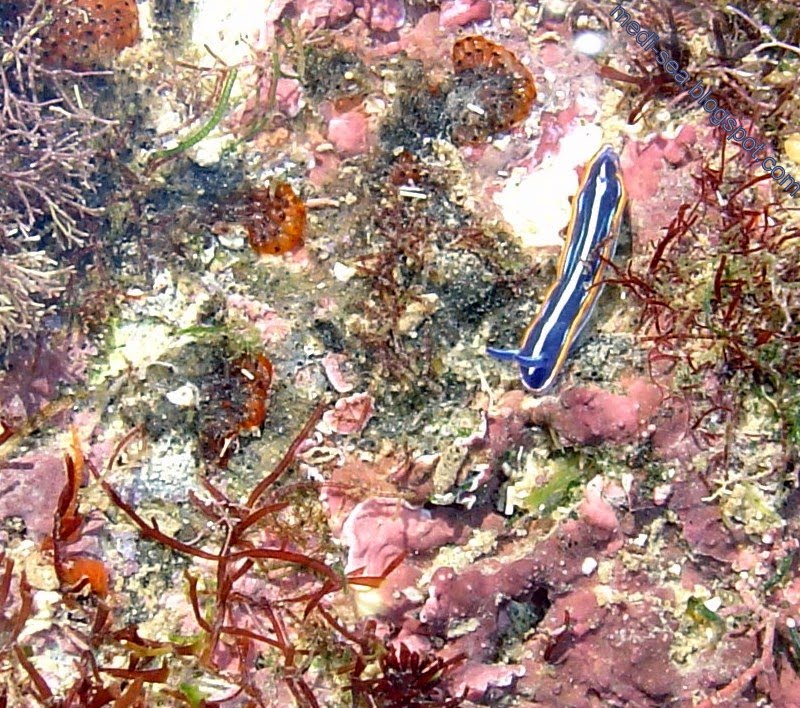
Except from having a great variable of color Hypsolodoris picta (as Elina inform us in the previous post) the nudibranch has and a great variable of cousins. The variable of color can reach to reddish coloration that we can meet at Cape Verde and the whitish coloration that we meet at several areas. The subspecies dividing of the species is ambiguous as the distribution of the species doesn’t match with the biologic taxonomy of the subspecies. In the photo above that provided to us by Konstantinos Vatikiotis we can admire an individual of the genus Hypselodoris (probably Hypselodoris villafranca but there is and a possibility to be a juvenile of H.picta). At the photos lower you can see more H.picta coloration and patterns. Have a look along with Frank!
First and second pic above from Santa Maria Paros, the third one is from Emporios bay Chios and the right above is from Kelifos island at Chalkidiki. All this locations are at Aegean sea.

15 Oct 2010

Variable colored beauty of the sea

The sea is full of suprises, we have seen this by now many times, but what never seems to astonish me is the suprises we find when we least expect them. Like yesterday for example, I dove in 4 meters of water in the muddy straight between Galatas and Poros, for training purposes.. I never go in the water without my one and only small camera, just for those suprises...and look what I found!
The beautiful Hypselodoris picta


This chromodorid is the largest of all chromodorids in the Mediterranean, reaching a size of 20 cm and it's distribution reaches as far as the Eastern Atlantic.
Because of its chromatic variations, this species has changed many names with the most common synonym being Hypselodoris elegans.
Nowdays, it has at least 5 subspecies depending on its locality and color.
This magnificent slug prefers to eat various sponges but its favorite food are sponges of the genus Dysidea.

20 Dec 2009

Christmas slug lights up the sea!


Dear friends of Medi Sea
Christmas is nearly here and we wanted to celebrate this time
with the most festive of Eastern Mediterranean slugs!
Janolus cristatus is a strikingly
beautiful opisthobranch and we nicknamed it "the bulb" (γλόμπος) because its
cerata are very much like glowing bulbs. If you look closely inside the transparent cerata you will notice the digestive gland ducts, which look like mushrooms!

These animals can grow to 75 mm in length and love to feed on bryozoans.
As beautiful as they are, they are very fragile so better not to touch them, only admire them from a distance.
Their egg sacs look like packets of pearls.
This specimen was photographed in Pilio but it's distribution reaches as far North as
Chalkidiki!
Happy Holidays
Happy Christmas dives
and all we want for Christmas is:
MARINE PROTECTED AREAS IN GREECE

22 Nov 2009

Under my umbrella


The umbrella snail is still a little confusion for the scientific research. There are probably two common species worldwide the Umbraculum umbraculum (Indo-Pacific region) and the Umbraculum mediterraneum (east Atlantic-Mediterranean region). A lot of researchers confuse this two species. More species of the family Umbraculidae have been found as fossils or just once. As we know most of the species of the (Subclass) Opisthobranchia have no shell. U.mediterraneum and Tylodina pervesa are the strangest species of the subclass as they have a small shell that looks like an umbrella over their body. U.mediterraneum is feeding on sponges and for that reason has a broad radula with rasping teethes. It can also bury in the sand near the sponges that it prefers for feeding. If you find it on the rocks it maybe impossible to spot as it can hide all his body between the umbrella shell and the rock. The animal in the photo was met at Paros at the depth of 1 meter and it is the shallower I have ever met.

29 Sept 2009

Funky slug making lurve circles...


The Eastern side of the Mediterranean, never seems to stop suprising us with its beauty!
Phyllidia flava is the only representative of the Phylidias, in the Med,
and here we have two specimens (yellow blob) on the two orange shponges, after they have layed their, not so perfect as usual, egg mases.
Phyllidias do not have radular teeth so these slugs eat the sponge by exuding enzymes and sucking the animal off the sceleton.
This photo was taken at 35 meters in Pilio.

18 Sept 2009

Melt with Melibe

I don't know how it happens, but the crappiest, cloudiest days are the best for underwater observation!
-This species of Melibe fimbriata was encountered at 10 meters free swimming and then attached on the sea grass, however the other time I encountered a much larger specimen, it was wallowing in the mud!
-The identification is hard as not many studies have been done in the Med, so until now most recordings are labeled as Melibe fimbriata
-It's a remarkable nudibranch, which has migrated from the Suez canal, an exotic species that is not native to the Mediterranean.
-It uses rhythmic lateral-bending movements, and can sometimes, travel long distances across open water. The upside-down, side-to-side thrashing motion may look awkward, but it is a complex series of movements which has been studied extensively.
-It feeds while attached to grasses, by extending its oral hood out and downward like a net. When the ventral surface of the hood contacts a small animal, the hood rapidly closes and the fringing tentacles overlap, holding in the prey then forcing the whole animal into the mouth. Prey include amphipods, copepods, mysids, other small crustaceans, small mollusks, small jellyfish and ctenophores, larvae of other invertebrates and in some cases small fish.


And one more picture from a wandering one at the surface. Probably she uses the current to move as she stays moveless just 1 meter under the surfave. (pic by hector)

14 Sept 2009

Find the nudi


In two meters of water in Pilion, there is a great abundance of Aplysina aerophoba sponges, and most of them are big and beautiful, except some that have been eaten to bits.....by this beautiful little slug called Tylodina perversa.
You can see on the picture of the sponge the places that have not been munched, and the others that have a duller appearance. The marks that the slug leaves are very big, however the sponge heals easily.
This specimen was a loyal highlight to all divers there, until one day I pass by and look on every sponge but he was not there, the only thing left was its cap..Eaten but never forgotten!

8 Aug 2009

Free green energy lesson!


This sweet little nudibranch is considered to be endemic for the Mediterrenean! We are lucky to have Elysia timida in our seas, but it is so small and timid, it's quite hard to spot, but a good start are the seaweed Acetabularia acetabulum and Padina pavonica, which are her favorite snacks! The really cool thing about this nudibranch is that it retains functional symbiotic chloroplasts from its food within the cells of its digestive system, providing it with nutrients ever after!

7 Aug 2009

Like a bee to honey


So this little beauty only prefers hydroids of the genus Eudendrium, this particular shot was taken 1 month ago in Nikiti, where we found only remnants of the hydroid as the Peregrina were feasting on whatever was left. Bon appetite!

14 Jun 2009

The snail that lost its' shell


- The time has come to start showing the snails that have evolved, abandoning their shell in their adult life. A hard cover protects from hungry predators, but these cute creatures evolved spectacular camouflage or chemical warfare for protection. This particular slug was frightened by me so it retracted its' rhinophores-sensory organs and gills (hole in the back of the picture). They can vary greatly in color within the Med, depending on what sponge they feast upon! They are common in Greece so keep your eye out!

11 Jun 2009

sex in the sea


-This is the time of loving in Marmaras Harbour-Chalkidiki, orgies of Bursatella leachi to be seen everywhere in different colorations.
-We dived in every corner of the harbour, but they seemed to prefer the muddier-dirtier parts.
-Dirty sex!!!!
-Loving World Ocean Day-June 8th

26 May 2009

Beautiful suprise in a dirty harbour


-It was a lucky day for Marmaras harbour this last Sunday, some divers from Poseidon Diving Center, participated in the Mediterranean SOS network cleanup and removed lots and lots of rubbish, toxic and non-toxic.
-In between the trash a beautiful primitive slug was lurking on the sea grass, probably looking for some tasty meaty snack to eat
-I was suprised to see how fast it moved for a slug!
-This species is a carnivore and may live in the sand also, so it was lucky we saw him!