 Right in the center of this photo you can see an ovular animal of beige/white colour. It is very small, up to 15mm and is most usually found on gorgonians Eunicella and Paramuricea spp. It's color depends on the color of the animal it is found on, from yellow to red or beige. However, the color changes on the mantle of the snail, the hard shell always remains a brilliant, glowing white. When Neosimnia picta is threatened, it retracts its mantle inside, exposing the outside shell (here visible as the white descending line in the middle of the animal). This mesogastropod is quite elusive, probably using pigments of the host gorgonian to change the color of the mantle, making it merge completely into the background. This photo is quite rare in that the snail was found on the substrate and not on the gorgonian! For its size, moving from one gorgonian to the other can be a long migration, but don't worry! It can move with surprising speed and reaches as far as 80 m! This animal was found on 35 meters in Kalamitsi, Chalkidiki.
Showing posts with label 03c (Class) Gastropoda. Show all posts
Showing posts with label 03c (Class) Gastropoda. Show all posts
13 Jul 2011
Is it a Nudibranch? Is it a sea slug? No! It's a mesogastropod!
Right in the center of this photo you can see an ovular animal of beige/white colour. It is very small, up to 15mm and is most usually found on gorgonians Eunicella and Paramuricea spp. It's color depends on the color of the animal it is found on, from yellow to red or beige. However, the color changes on the mantle of the snail, the hard shell always remains a brilliant, glowing white. When Neosimnia picta is threatened, it retracts its mantle inside, exposing the outside shell (here visible as the white descending line in the middle of the animal). This mesogastropod is quite elusive, probably using pigments of the host gorgonian to change the color of the mantle, making it merge completely into the background. This photo is quite rare in that the snail was found on the substrate and not on the gorgonian! For its size, moving from one gorgonian to the other can be a long migration, but don't worry! It can move with surprising speed and reaches as far as 80 m! This animal was found on 35 meters in Kalamitsi, Chalkidiki.

18 Oct 2010
More variable more watchers.
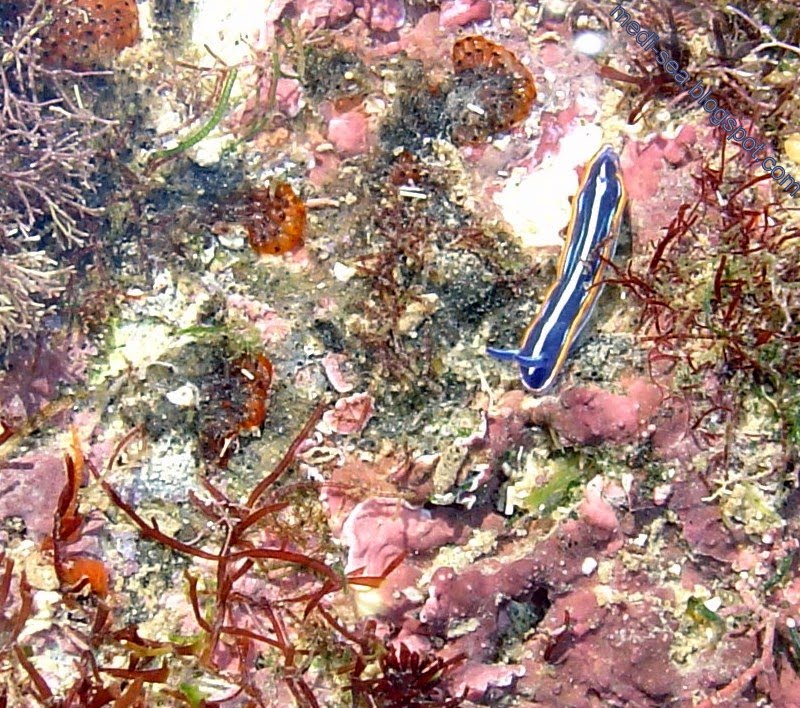 Except from having a great variable of color Hypsolodoris picta (as Elina inform us in the previous post) the nudibranch has and a great variable of cousins. The variable of color can reach to reddish coloration that we can meet at Cape Verde and the whitish coloration that we meet at several areas. The subspecies dividing of the species is ambiguous as the distribution of the species doesn’t match with the biologic taxonomy of the subspecies. In the photo above that provided to us by Konstantinos Vatikiotis we can admire an individual of the genus Hypselodoris (probably Hypselodoris villafranca but there is and a possibility to be a juvenile of H.picta). At the photos lower you can see more H.picta coloration and patterns. Have a look along with Frank!


 First and second pic above from Santa Maria Paros, the third one is from Emporios bay Chios and the right above is from Kelifos island at Chalkidiki. All this locations are at Aegean sea.
15 Oct 2010
Variable colored beauty of the sea
The sea is full of suprises, we have seen this by now many times, but what never seems to astonish me is the suprises we find when we least expect them. Like yesterday for example, I dove in 4 meters of water in the muddy straight between Galatas and Poros, for training purposes.. I never go in the water without my one and only small camera, just for those suprises...and look what I found!
The beautiful Hypselodoris picta

This chromodorid is the largest of all chromodorids in the Mediterranean, reaching a size of 20 cm and it's distribution reaches as far as the Eastern Atlantic.
Because of its chromatic variations, this species has changed many names with the most common synonym being Hypselodoris elegans.
Nowdays, it has at least 5 subspecies depending on its locality and color.
This magnificent slug prefers to eat various sponges but its favorite food are sponges of the genus Dysidea.
The beautiful Hypselodoris picta

This chromodorid is the largest of all chromodorids in the Mediterranean, reaching a size of 20 cm and it's distribution reaches as far as the Eastern Atlantic.
Because of its chromatic variations, this species has changed many names with the most common synonym being Hypselodoris elegans.
Nowdays, it has at least 5 subspecies depending on its locality and color.
This magnificent slug prefers to eat various sponges but its favorite food are sponges of the genus Dysidea.
9 Sept 2010
Strangers with the strangest eyes.
In an older post we talked about C.Mediterraneus and how lonely it feels in our seas, because none of the 400 members of its family live in our neighborhood. In our fantasy, we can imagine that a similar (it actually only looks similar) species heard its sad story and visited him to live in the neighborhood with big opportunities for the marine animals. It is called Strombus persicus and comes at Medisea from the east as an immigrant. It is also the only member of its family in the region (a second species may have beem possibly established, the Strombus mutabilis).

Strombus sp. are strange gastropods with big human-like eyes. When you see it you think that you are looking at something different than a snail. Maybe a cursed mermaid, who knows? Except from its strange eyes it has an unexpected way of moving. Its operculum is sickle-shaped and hooks to the bottom helping the snail to move. The movement looks like little jumps and it’s very different from the sliding movement of the other snails. For its bad luck it is not able to dig with the strange operculum. If it digs it can find fossils of a famous big snail that lived at the Mediterranean Sea before thousands of years called Strombus bubonius.
Info about the superfamily Stromboidea you can find on this site!!!

Strombus bubonius; Tyrrhen, 97.000 years old, Pleistocene; San Juan de los Terreros, Almeria, Spain; 82 mm; Coll. Aart Dekkers STR9063
Photo contributed by www.stromboidea.de and Mr.Aart Dekkers

Strombus sp. are strange gastropods with big human-like eyes. When you see it you think that you are looking at something different than a snail. Maybe a cursed mermaid, who knows? Except from its strange eyes it has an unexpected way of moving. Its operculum is sickle-shaped and hooks to the bottom helping the snail to move. The movement looks like little jumps and it’s very different from the sliding movement of the other snails. For its bad luck it is not able to dig with the strange operculum. If it digs it can find fossils of a famous big snail that lived at the Mediterranean Sea before thousands of years called Strombus bubonius.
Info about the superfamily Stromboidea you can find on this site!!!

Strombus bubonius; Tyrrhen, 97.000 years old, Pleistocene; San Juan de los Terreros, Almeria, Spain; 82 mm; Coll. Aart Dekkers STR9063
Photo contributed by www.stromboidea.de and Mr.Aart Dekkers
3 Jun 2010
I'm sticking with you

Limpets are gastropod shells but they do not have the typical gastropod shell shape, as can be seen in the picture. The common hey hole limpet can reach 40 mm long and can be found in the Mediterranean sea, but no longer in the North Sea, any specimens in the south eastern part of the North sea that are washed out are thought to be fossils. When viewed from above, Diodora graeca, is oval shaped with radiating ribs and bold growth lines. The color varies from creamy to yellow white often with brown, radiating rays. The hole on the top of the shell serves as an outlet for water and waste products. It can be found in deep water up to 200 meters, but this specimen was photographed in Platanitsi at a depth of 10 m. Just like other limpets it adheres firmly on the sides of rocks, making it very hard to detach, unless you use a knife...but why would you do that to such a beautiful, docile creature. This family is mostly herbivorous but the key hole limpet likes to feed on certain species of sponge, especially Halichondria and Hymeniacidon.
And as the Velvet Underground song goes.....I'm sticking with you....coz' I'm made out of glue!
12 Mar 2010
Tiny creature with brilliant color

Take a look inside the shadowy hole. Something strange seems to be there. It's bad luck that my curiosity disturbs its peace,but I cannot let this chance for a better look at this strange color, go by. Luckily it’s stuck on a stone which can be moved. I really don’t like to disturb the creatures I meet and I rarely do, unless it is something really unique and I cannot take a photo otherwise. It is a tiny limpet and it has a color that I have never seen before on a limpet. Its size is not bigger than 3mm and it was very hard to take this picture with a compact camera that I found on a nearby diver’s hand (thank you Hildegard)!!! I asked Spanish collaborator of www.sealifebase.org Victor Simon if he knows which species it is and he thought that it is a Leptea fulva but he cannot be sure. The shape and the color indicate to this but L.fulva it usually lives deep. Limpets are members of the Superfamily Patellacea of the Order Archaeogastropoda which are the first Gastropoda in the evolution (Archaeo is from a greek word which means ancient).
3 Mar 2010
Snail attack!

On the previous post we saw a tiny, lonely Bittium shell balancing over the huge Pina shell!
Very impressive site caught on camera. This picture shows a mass of Bittium shells muching on the seagrass Zostera marina. These masses are more oftenly encountered in the summer months and less likely in the colder months. If you are swimming by quickly it looks like the seaweed is dirty, but look a little closer and you will see so many tiny little shells, of all colors!
It is a pity the photo was not very clear, but it is very hard for me to focus on something so small with seaweed everywhere. By the end of this summer season expect to find a big variety of miniscule shells that live in the Greek waters. I have collected their dead shells all my life, now is the time for the live animals...stay tuned!
26 Feb 2010
Walking on cliff’s edge?

This tiny gastropod is one of the smallest shells that we can observe in our sea. I think it’s much easier to spot it if it chooses to go for a walk over the Mediterranean's biggest shell Pina nobilis! In this photo, given to us by our friend Sokratis Karalis, the small shell looks like walking between a cliff and a river (it’s a Greek expression don’t blame me if you didn’t understand). I am very happy when I find nice pictures from Mediterranean not so fancy animals. It is very hard to tell which of the Bittium sp. it is but most often we meet at the depths the Bittium latreillii (Payraudeau, 1826).
Sometimes I have detected Bittium sp. between urchin spines so I think these tiny animals are nature’s admirers like all of us.
27 Dec 2009
The Green Ormer

These shells are popularly called sea-ears and the scientific name Haliotis comes from the Greek halios and otis meaning ear.
They are a single shelled gastropod that crawls over the rocks feeding on algae. It can grow up to 12 cm and the interior of the shell is a magnificent wavy mother-of-pearl covering. They have separate sexes and breed in the summer. Masters of camouflage with calcareous algae and other seaweeds living on their shell, they can easily be sniffed out by octopus..look closely in the following picture

Their flesh is prized both by men and octopi... today, on what it seems like the last dive of the year,..a very big ear-shell was just about to be eaten by a viciously hungry octopus, when "tank girl" came to the rescue to get a photo...the octopus left slowly towards the right leaving the very expanded shell to its peace, towards the left.
In this incident we can see the rare situation of the shell's mantle being completely expanded outwards giving it a frilly white margin, and the octopus looking very annoyed...
It seems the French love this shell and it has a history for heavy fishing north until the Channel Islands, where they first beat the hard flesh and then fry it////it is delicious!
So, to close off this first year of Medi-sea..adventures
Sea ear, Sea ear
if you can hear
all we want for New Year
No more all around trawling gear/fear
MARINE PROTECTED AREAS IN GREECE, NOW
and many love Hugs and Fishes
to All and to All good night
20 Dec 2009
Christmas slug lights up the sea!

Dear friends of Medi Sea
Christmas is nearly here and we wanted to celebrate this time
with the most festive of Eastern Mediterranean slugs!
Janolus cristatus is a strikingly
beautiful opisthobranch and we nicknamed it "the bulb" (γλόμπος) because its
cerata are very much like glowing bulbs. If you look closely inside the transparent cerata you will notice the digestive gland ducts, which look like mushrooms!
These animals can grow to 75 mm in length and love to feed on bryozoans.
As beautiful as they are, they are very fragile so better not to touch them, only admire them from a distance.
Their egg sacs look like packets of pearls.
This specimen was photographed in Pilio but it's distribution reaches as far North as
Chalkidiki!
Happy Holidays
Happy Christmas dives
and all we want for Christmas is:
MARINE PROTECTED AREAS IN GREECE
22 Nov 2009
Under my umbrella
.JPG)
The umbrella snail is still a little confusion for the scientific research. There are probably two common species worldwide the Umbraculum umbraculum (Indo-Pacific region) and the Umbraculum mediterraneum (east Atlantic-Mediterranean region). A lot of researchers confuse this two species. More species of the family Umbraculidae have been found as fossils or just once. As we know most of the species of the (Subclass) Opisthobranchia have no shell. U.mediterraneum and Tylodina pervesa are the strangest species of the subclass as they have a small shell that looks like an umbrella over their body. U.mediterraneum is feeding on sponges and for that reason has a broad radula with rasping teethes. It can also bury in the sand near the sponges that it prefers for feeding. If you find it on the rocks it maybe impossible to spot as it can hide all his body between the umbrella shell and the rock. The animal in the photo was met at Paros at the depth of 1 meter and it is the shallower I have ever met.
10 Nov 2009
Hexaplex trunculus
.JPG)

Attacking a Callista chione bivalve shell.

The hatching of the eggs doesn't happen at the same time as you can see from this photo.
One common gastropod of the Mediterranean Sea is the Hexaplex trunculus or Banded Murex. This snail was very popular through the ancient times because it was used to produce purple dye. It is also used as bait for long-lines. A hunter with great success against bivalve shells (photo)but it also likes dead fishes. It is powerful enough to make holes in bivalve shells. Fishermen attract them by throwing dead fishes and crabs. Over its shell can grow weeds, asbestolithic weeds and sponges. The most impressive point in its life is its reproduction. It has separate sexes and a lot of individuals spawn over the same place making that strange group of eggs that we can find in the shallow water (photo). The first nymph stages of his life passes inside the egg and it hatches as a crawling shell. It lives in polluted areas and sometimes this results in finding female animals with male genitals.
29 Sept 2009
Funky slug making lurve circles...

The Eastern side of the Mediterranean, never seems to stop suprising us with its beauty!
Phyllidia flava is the only representative of the Phylidias, in the Med,
and here we have two specimens (yellow blob) on the two orange shponges, after they have layed their, not so perfect as usual, egg mases.
Phyllidias do not have radular teeth so these slugs eat the sponge by exuding enzymes and sucking the animal off the sceleton.
This photo was taken at 35 meters in Pilio.
22 Sept 2009
Conus the Mediterranean
.jpg)
.jpg)
Conus mediterraneus is far away from his family. He belongs to a great family of snails with more than 400 species. Unfortunately he is the only specie of the family Conidae at the Mediterranean sea. Once at 1986 a cousin of him C.fumigatus visit him from the Red sea that he lived but he didn't stay for a lot. So C.mediterraneus continues his life by hunting polychaetes and other animals with his venomous harpoon!!! You can find him at shallow water hanging around with a lazy style.
Photos from Kolimpithres beach Paros.
Conus ventricosus is a synonym.
18 Sept 2009
Melt with Melibe
I don't know how it happens, but the crappiest, cloudiest days are the best for underwater observation!
-This species of Melibe fimbriata was encountered at 10 meters free swimming and then attached on the sea grass, however the other time I encountered a much larger specimen, it was wallowing in the mud!
-The identification is hard as not many studies have been done in the Med, so until now most recordings are labeled as Melibe fimbriata
-It's a remarkable nudibranch, which has migrated from the Suez canal, an exotic species that is not native to the Mediterranean.
-It uses rhythmic lateral-bending movements, and can sometimes, travel long distances across open water. The upside-down, side-to-side thrashing motion may look awkward, but it is a complex series of movements which has been studied extensively.
-It feeds while attached to grasses, by extending its oral hood out and downward like a net. When the ventral surface of the hood contacts a small animal, the hood rapidly closes and the fringing tentacles overlap, holding in the prey then forcing the whole animal into the mouth. Prey include amphipods, copepods, mysids, other small crustaceans, small mollusks, small jellyfish and ctenophores, larvae of other invertebrates and in some cases small fish.
And one more picture from a wandering one at the surface. Probably she uses the current to move as she stays moveless just 1 meter under the surfave. (pic by hector)
+(Medium)+(Small).JPG)
-This species of Melibe fimbriata was encountered at 10 meters free swimming and then attached on the sea grass, however the other time I encountered a much larger specimen, it was wallowing in the mud!
-The identification is hard as not many studies have been done in the Med, so until now most recordings are labeled as Melibe fimbriata
-It's a remarkable nudibranch, which has migrated from the Suez canal, an exotic species that is not native to the Mediterranean.
-It uses rhythmic lateral-bending movements, and can sometimes, travel long distances across open water. The upside-down, side-to-side thrashing motion may look awkward, but it is a complex series of movements which has been studied extensively.
-It feeds while attached to grasses, by extending its oral hood out and downward like a net. When the ventral surface of the hood contacts a small animal, the hood rapidly closes and the fringing tentacles overlap, holding in the prey then forcing the whole animal into the mouth. Prey include amphipods, copepods, mysids, other small crustaceans, small mollusks, small jellyfish and ctenophores, larvae of other invertebrates and in some cases small fish.
And one more picture from a wandering one at the surface. Probably she uses the current to move as she stays moveless just 1 meter under the surfave. (pic by hector)
+(Medium)+(Small).JPG)
14 Sept 2009
Find the nudi

In two meters of water in Pilion, there is a great abundance of Aplysina aerophoba sponges, and most of them are big and beautiful, except some that have been eaten to bits.....by this beautiful little slug called Tylodina perversa.
You can see on the picture of the sponge the places that have not been munched, and the others that have a duller appearance. The marks that the slug leaves are very big, however the sponge heals easily.
This specimen was a loyal highlight to all divers there, until one day I pass by and look on every sponge but he was not there, the only thing left was its cap..Eaten but never forgotten!
8 Aug 2009
Free green energy lesson!

This sweet little nudibranch is considered to be endemic for the Mediterrenean! We are lucky to have Elysia timida in our seas, but it is so small and timid, it's quite hard to spot, but a good start are the seaweed Acetabularia acetabulum and Padina pavonica, which are her favorite snacks! The really cool thing about this nudibranch is that it retains functional symbiotic chloroplasts from its food within the cells of its digestive system, providing it with nutrients ever after!
7 Aug 2009
Like a bee to honey

So this little beauty only prefers hydroids of the genus Eudendrium, this particular shot was taken 1 month ago in Nikiti, where we found only remnants of the hydroid as the Peregrina were feasting on whatever was left. Bon appetite!
14 Jun 2009
The snail that lost its' shell

- The time has come to start showing the snails that have evolved, abandoning their shell in their adult life. A hard cover protects from hungry predators, but these cute creatures evolved spectacular camouflage or chemical warfare for protection. This particular slug was frightened by me so it retracted its' rhinophores-sensory organs and gills (hole in the back of the picture). They can vary greatly in color within the Med, depending on what sponge they feast upon! They are common in Greece so keep your eye out!
11 Jun 2009
sex in the sea


-This is the time of loving in Marmaras Harbour-Chalkidiki, orgies of Bursatella leachi to be seen everywhere in different colorations.
-We dived in every corner of the harbour, but they seemed to prefer the muddier-dirtier parts.
-Dirty sex!!!!
-Loving World Ocean Day-June 8th
Subscribe to:
Posts (Atom)