21 Feb 2011

The fish that fishes....Το ψάρι που ψαρεύει!


The biodiversity of fish shapes and forms reminds me of the
immense shapes and forms found in the rain-forest insects!
This month we offer for your viewing and icthyological pleasure
the magnificent Angler fish or Peskandritsa in Greek.
Another synomym is the Monk fish, with the females of the species
reaching the spectacular length of 2m, 40 kg!
To encounter even a small specimen is a fantastic experience,
firstly because of its mouth, which basically makes up most of
the body! The angler fish gets its name from a small fishing appendage
found on the top of the head, which originates
from one of the three modified dorsal spines.This fishing lure
attracts mostly small fish, however the angler fish with its
massive mouth can engulf fish as big as itself, and digest them easily in its expandable stomach! On the first photo we can clearly see the seaweed like
appendages, circling the mouth which can change color depending on the
environment, making this fish another master in camouflage, whether it is
lying on sand or rocky bottoms.
Another strange aspect of this animal is the use of its modified pelvic and pectoral fins as legs, which it uses to move around, along with a sudden burst of its tail.
On this video provided by our good friend Michalis, you can see this behavior on minute 2. The monk fish is highly commercial, however its status is not evalluated yet for the IUCN red list. It is always sold skinned and without a head, so basically
what you eat is the tail... not a lot from such a big fish, so it is best left alone
lurking on the sea bottom, fishing other small fish or even sea birds!

1 Jan 2011

..><(((º>··..><(((º>··..><(((º>··..><(((º>

In the past year we have witnessed many wonders of the sea and felt many sorrows from its continual demise.
We want to start the new year with a celebration of life a new way a new life
and exorcise the negativity and abuse we impose on the environment and ourselves.
Real change in the world can start only from within, deep within!
I made this video from pictures of dives made in 2010, memories that last a lifetime

28 Nov 2010

Sandy bottom delights


This time we were looking for sea horses but instead we found rays, many many rays!
The sandy bottom realm sounds quite boring, divers stay well away of it, but the sandy bottom hosts an array of very interesting and beautiful inhabitants. Today we present the skate/ray Raja radula,one of the most common rays of the Mediterranean,with some evidence towards its endemism in the area, as the specimens found off the Atlantic could have been misidentified with other similar species, not very hard to do with these rays.
This ray is completely harmless to humans, it has no thorn, like the sting rays and no electricity like the torpedo rays, however the skin around the tail is quite rough, hence its common name, rough ray.
This fish inhabits shallow water until the depths of 300 meters,and this particular specimen was photographed in Stratoni at the depth of 10 meters.All in all, on a 50 minute dive, we spotted 4 animals laying on the sandy sea bottom.
They prefer to eat any type of bottom animals, making Stratoni a haven of food for them!
They are oviparous, laying oblong egg capsules with stiff pointy horns on the ends (mermaid purses). About 80-154 eggs are laid by an individual in a year. Because of insufficient data on their populations it is listed as Data Deficient on the IUCN Red List.

3 Nov 2010

Triggerfish journeys

Photo by Vasilis Mentogiannis

After all these years of diving, travelling and exploring the seas of the world, this was the year I said with the most certainty that even if I only dive here,in Greece, for the rest of my life and nowhere else, I will be happy and content!
Dive Greece Baby!
The beauty of our sea is not only very well hidden and currently very fragile but also it is very little acknowledged. One example, is a completely exotic animal the Triggerfish, which usually lives in tropical seas. The Grey triggerfish (Γουρονόψαρο η Βαλιστής) is a resident of the East and West Atlantic, all the way down to Argentina with rarer occurrences in the East Mediterranean.

Balistidae is a family containing 40 species but only Balistes carolinensis (synonym Ballistes capriscus)can be found in Greece. As a family, these fish are most extraordinary, with colorful lines and spots, especially in their Indopacific range. Their name, triggerfish, comes from the locking mechanism of their anterior dorsal fin, which is composed of 3 spines that fit inside a groove, while only 2 work as a trigger. When the first, (anterior) spine is locked in place by erection of the short second spine, then it can only be unlocked by depressing the second, “trigger” spine.

Another peculiarity of the triggerfish, is their aggressive behavior against other fish in small aquaria, or divers when they approach a nest of eggs. At this point, it is advisable to swim away from the nest and not over it, as their territory is conical reaching to the surface. If you add the aggressive behavior of these fish, along with their strong, fused teeth, you have one vicious, unnecessary bite! Some strong attacks have been mentioned from bigger, more tropical species, but for the Grey triggerfish this has not been reported.
Balistes carolinensis prefer to eat small crustaceans and mollusks from the benthos. Their skin is very tough and leathery.
It seems that this particular individual is a juvenile, because the tips of its caudal fin are not elongated yet। As an adult it can reach the size of 60cm! Their reproductive season is in the summer, when spawn is placed inside a crater on the sand, and is guarded by the female (male in the tropics), a sure sign you should swim around and not over the nest!
The color of the Grey triggerfish is mostly grey with brilliant fluorescent turquoise dots on upper half of body and median fins, and irregular short lines ventrally. There may also be three faint irregular broad dark bars on body and a narrow pale transverse band on the chin.

This particular beauty was hanging out under the traditional fishing boat (kaiki) Agios Nikolaos, the boat that broke the embargo to Gaza in the summer of 2008 http://www.youtube.com/watch?v=8gRscVeNbDo&feature=related.
The second expedition took place this year with tragic consequences....


The boat was anchored next to the Isle of Modi in the NE Peloponnese, but that is a whole different adventure soon to come on Medi Sea!
Until then, thank you Vasilis for capturing the elusive fish!

28 Oct 2010

the third, the unknown the luckiest.


While swimming at Chorto bay in the Pagasitic gulf, I had the chance to check the marine life that lives associated with the Aplysina aerophoba sponges. I wasn’t alone, as this tiny fish had the same interests with me. It is the third, the smallest and the most unknown common fish species of the genus Serranus in the Eastern Meditteranean Sea.

Scientists of Ichthyology give it the humble name Serranus hepatus. I don’t think that this defame matters the fish, as its famous cousins are famous because fishermen catch them with hooks. It doesn’t feel unhappy of this because it knows that it’s better being an insignificant swimmer, than fried and famous. You can differentiate it from the Serranus cabrilla by the big black spot on its dorsal fin.

More information about our friend can be found in studies made by Abdoulaye Wague (in Greek click here) and Murat Bilecenoglu (in English and Turkish click here) .

24 Oct 2010

Running to the shelters!

.........................The presence of Elina alerts the hermit crabs.


As the naturalist approaches the sponge,he can notice a lot of tiny shells loosing their balance and falling down. In previous posts we saw the symbiosis (or the vicinity) between the sponge, mollusks and polychaeta. The structure of the sponge Aplysina aerophoba provides shelter also to the third major group of benthic fauna, the crustaceans. The little shells (except some Bittium sp) are the houses of the small hermit crabs. In the macro photo I think that you can see a young Pagurus anachoretus but it is too small to recognize. I was very impressed by the fast and simultaneous reaction of the tiny hermit crabs. As I got close to the sponge, at once all of them left their shell to fall from the walls of the sponge to the lower darker parts of the sponge. I don’t know if there is a possibility of communication between the hermit crabs, but what about the sponge? Sponges don’t have nerves but as an animal they find other ways to inform the rest of the body for what is happening. Maybe there is a sign by the sponge that can be recognized by the crabs? It’s very difficult to know but it’s nice as a scenario. Who knows maybe we learn in the next posts of the blog.

18 Oct 2010

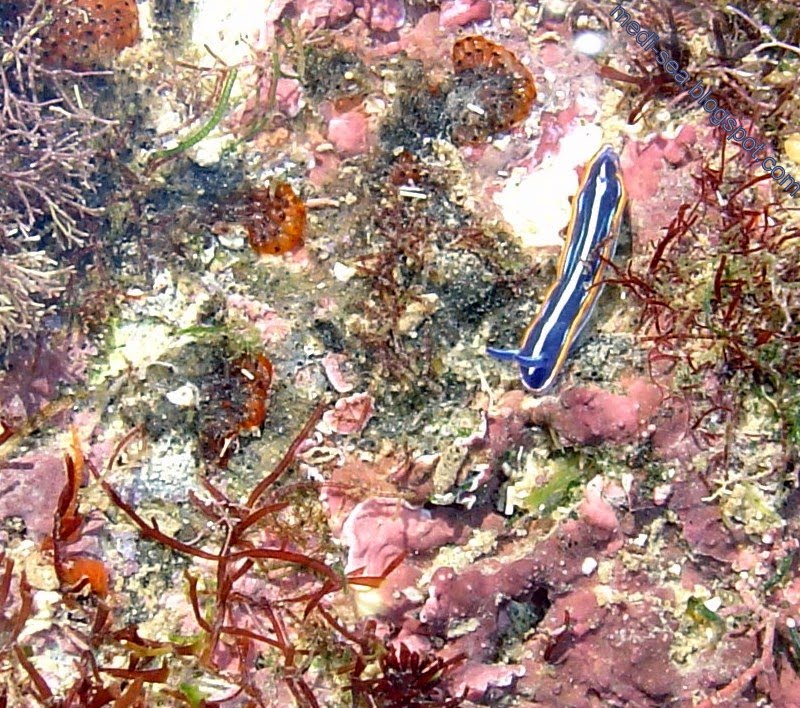
More variable more watchers.

Except from having a great variable of color Hypsolodoris picta (as Elina inform us in the previous post) the nudibranch has and a great variable of cousins. The variable of color can reach to reddish coloration that we can meet at Cape Verde and the whitish coloration that we meet at several areas. The subspecies dividing of the species is ambiguous as the distribution of the species doesn’t match with the biologic taxonomy of the subspecies. In the photo above that provided to us by Konstantinos Vatikiotis we can admire an individual of the genus Hypselodoris (probably Hypselodoris villafranca but there is and a possibility to be a juvenile of H.picta). At the photos lower you can see more H.picta coloration and patterns. Have a look along with Frank!
First and second pic above from Santa Maria Paros, the third one is from Emporios bay Chios and the right above is from Kelifos island at Chalkidiki. All this locations are at Aegean sea.