The sea is full of suprises, we have seen this by now many times, but what never seems to astonish me is the suprises we find when we least expect them. Like yesterday for example, I dove in 4 meters of water in the muddy straight between Galatas and Poros, for training purposes.. I never go in the water without my one and only small camera, just for those suprises...and look what I found!
The beautiful
Hypselodoris picta
This chromodorid is the largest of all chromodorids in the Mediterranean, reaching a size of 20 cm and it's distribution reaches as far as the Eastern Atlantic.
Because of its chromatic variations, this species has changed many names with the most common synonym being
Hypselodoris elegans.
Nowdays, it has at least 5 subspecies depending on its locality and color.
This magnificent slug prefers to eat various sponges but its favorite food are sponges of the genus Dysidea.
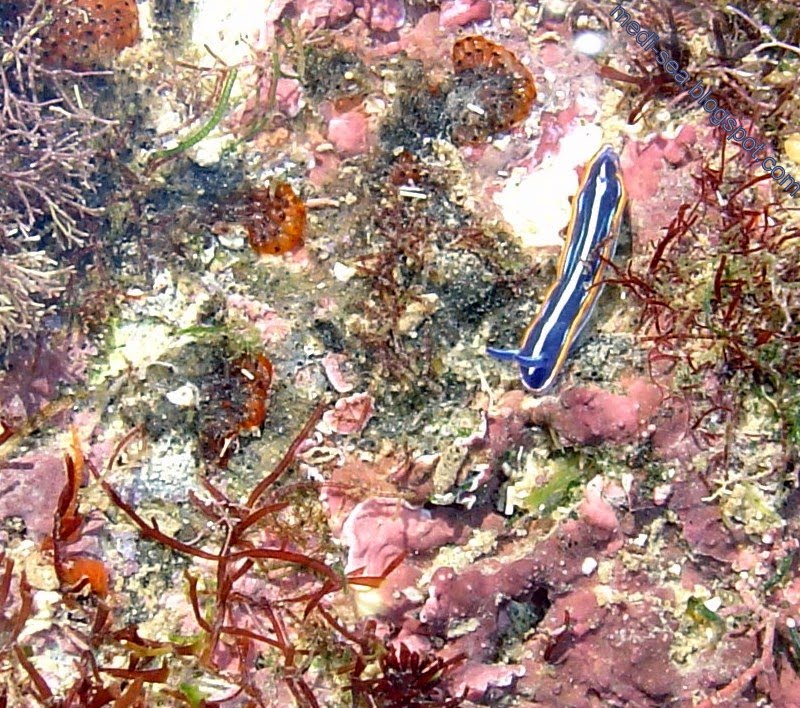 Except from having a great variable of color Hypsolodoris picta (as Elina inform us in the previous post) the nudibranch has and a great variable of cousins. The variable of color can reach to reddish coloration that we can meet at Cape Verde and the whitish coloration that we meet at several areas. The subspecies dividing of the species is ambiguous as the distribution of the species doesn’t match with the biologic taxonomy of the subspecies. In the photo above that provided to us by Konstantinos Vatikiotis we can admire an individual of the genus Hypselodoris (probably Hypselodoris villafranca but there is and a possibility to be a juvenile of H.picta). At the photos lower you can see more H.picta coloration and patterns. Have a look along with Frank!


 First and second pic above from Santa Maria Paros, the third one is from Emporios bay Chios and the right above is from Kelifos island at Chalkidiki. All this locations are at Aegean sea.

