24 Oct 2010

Running to the shelters!

.........................The presence of Elina alerts the hermit crabs.


As the naturalist approaches the sponge,he can notice a lot of tiny shells loosing their balance and falling down. In previous posts we saw the symbiosis (or the vicinity) between the sponge, mollusks and polychaeta. The structure of the sponge Aplysina aerophoba provides shelter also to the third major group of benthic fauna, the crustaceans. The little shells (except some Bittium sp) are the houses of the small hermit crabs. In the macro photo I think that you can see a young Pagurus anachoretus but it is too small to recognize. I was very impressed by the fast and simultaneous reaction of the tiny hermit crabs. As I got close to the sponge, at once all of them left their shell to fall from the walls of the sponge to the lower darker parts of the sponge. I don’t know if there is a possibility of communication between the hermit crabs, but what about the sponge? Sponges don’t have nerves but as an animal they find other ways to inform the rest of the body for what is happening. Maybe there is a sign by the sponge that can be recognized by the crabs? It’s very difficult to know but it’s nice as a scenario. Who knows maybe we learn in the next posts of the blog.

18 Oct 2010

More variable more watchers.

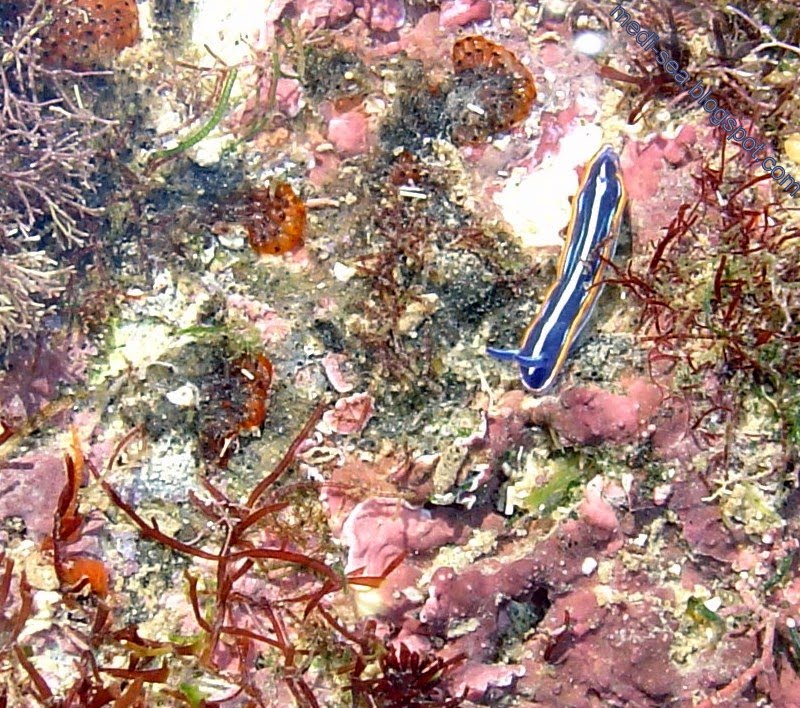
Except from having a great variable of color Hypsolodoris picta (as Elina inform us in the previous post) the nudibranch has and a great variable of cousins. The variable of color can reach to reddish coloration that we can meet at Cape Verde and the whitish coloration that we meet at several areas. The subspecies dividing of the species is ambiguous as the distribution of the species doesn’t match with the biologic taxonomy of the subspecies. In the photo above that provided to us by Konstantinos Vatikiotis we can admire an individual of the genus Hypselodoris (probably Hypselodoris villafranca but there is and a possibility to be a juvenile of H.picta). At the photos lower you can see more H.picta coloration and patterns. Have a look along with Frank!
First and second pic above from Santa Maria Paros, the third one is from Emporios bay Chios and the right above is from Kelifos island at Chalkidiki. All this locations are at Aegean sea.

15 Oct 2010

Variable colored beauty of the sea

The sea is full of suprises, we have seen this by now many times, but what never seems to astonish me is the suprises we find when we least expect them. Like yesterday for example, I dove in 4 meters of water in the muddy straight between Galatas and Poros, for training purposes.. I never go in the water without my one and only small camera, just for those suprises...and look what I found!
The beautiful Hypselodoris picta


This chromodorid is the largest of all chromodorids in the Mediterranean, reaching a size of 20 cm and it's distribution reaches as far as the Eastern Atlantic.
Because of its chromatic variations, this species has changed many names with the most common synonym being Hypselodoris elegans.
Nowdays, it has at least 5 subspecies depending on its locality and color.
This magnificent slug prefers to eat various sponges but its favorite food are sponges of the genus Dysidea.

8 Oct 2010

Pompanos as companions


This summer, never was I lonely on the shallow dives. The minute I jumped in the water 3 beautiful Pompanos(Trachinotus ovatus, Litsa, Mavrolitsa or Gofari in Greek) appeared immediately and were our loyal followers throughout the dive. They swim very fast, in a most elegant fashion and their curiosity is high, coming very close to swimmers without fear.
Their tail is fork shaped as is typical of the carangids, with a black spot on the tip of the caudal, dorsal and anal fins. They also have 3 - 5 dark spots on the front end of their body. The biggest specimen recorded was measured at 70 cm, although most commonly at 35 cm. Its distribution has been recorded from the Eastern Atlantic, Bay of Biscay, British and Scandinavian waters (rare) to Angola, including the Mediterranean Sea and offshore islands.
They usually swim in small schools near the coast in shallow waters, over sandy or muddy bottoms, unlike their other relatives of the amazing family Carangidae, which are mostly pelagic. They mostly prefer to eat small crustaceans, mollusks and fishes.
For this reason they are easy to spot and photograph.
Pompanos have a high salinity tolerance and are in the process of being farmed in China although they have a low food conversion rate, with trials being made to grow them using soyabean and fishmeal.

9 Sept 2010

Strangers with the strangest eyes.

In an older post we talked about C.Mediterraneus and how lonely it feels in our seas, because none of the 400 members of its family live in our neighborhood. In our fantasy, we can imagine that a similar (it actually only looks similar) species heard its sad story and visited him to live in the neighborhood with big opportunities for the marine animals. It is called Strombus persicus and comes at Medisea from the east as an immigrant. It is also the only member of its family in the region (a second species may have beem possibly established, the Strombus mutabilis).

Strombus sp. are strange gastropods with big human-like eyes. When you see it you think that you are looking at something different than a snail. Maybe a cursed mermaid, who knows? Except from its strange eyes it has an unexpected way of moving. Its operculum is sickle-shaped and hooks to the bottom helping the snail to move. The movement looks like little jumps and it’s very different from the sliding movement of the other snails. For its bad luck it is not able to dig with the strange operculum. If it digs it can find fossils of a famous big snail that lived at the Mediterranean Sea before thousands of years called Strombus bubonius.
Info about the superfamily Stromboidea you can find on this site!!!

Strombus bubonius; Tyrrhen, 97.000 years old, Pleistocene; San Juan de los Terreros, Almeria, Spain; 82 mm; Coll. Aart Dekkers STR9063
Photo contributed by www.stromboidea.de and Mr.Aart Dekkers

7 Sept 2010

Volcanoes, roses and a prince.


On little Santa Maria beach,Paros, if you swim at the depth of 4-5 meters and deeper, on the sandy parts you may notice a lot of small hills with a hole in the top. These “volcanoes” are nests of marine animals. Bivalves or worms are the most possible inhabitants of the volcanoes but until now I didn’t have the chance to check it. When the volcano is dirty,it has the same behavior with all the volcanoes. It explodes and you can notice small stones throwing away from the hole.
Of course, and as in every lonely planet, except from the volcanoes you can also see roses. The roses of the area are alive and have a worm inside them. They are spiral tube worms but for we will talk more about them in future posts. So the volcano is dirty and the rose alone? Of course not! Our planet has its capricious prince, the little weever. It is capricious because if you annoy him it will give you his poison. (stop the pain by putting the injured area in hot water 44C to 49C). It spends its day by laying over the volcano and negotiating the terms of volcano cleanliness with the worm, trying to help the rose with the existential thoughts. That's how our friends spend their day on the sandy beach.

When the roses ideas make our hero tired, he prefers to bury himself instead of going away.

The volcano is such a good place for scanning around and resting.

The hard thing is to convince the worm to let you clean the volcano.

Casting: The little prince : Trachinus draco
The rose : Sabella spallazanii ???
The volcanoes : species from phylums Annelida or Mollusca.

Check the history and the wreck-story of the original inspired author at wikipedia

4 Sept 2010

Close Encounters of the Third Kind


When I went to Athens on late of June, I met my father who showed me some pics of the strange fish that live under his boat. It was a pic from the anchoring rope of the boat where you could see three shadows standing by the side of the rope. Exactly in the same place (in the same rope) and before 2 years I had first met the Cornetfishes that live at Mediterranean sea. I met them as we were coming back from a dive with Elina, and as we were getting out of the boat I spotted the same shadows from my fathers pics. Fast and cautiously (because it was illegal to dive there as there where running construction works) I slid into water for two minutes to take these pictures. In the pics you can see one of the small cornetfish from that contact. It has a very strange tail with a membrane being in the place of the whiplash that usually exists at the end of the cornetfish tail.
My last contact with the invading alien "ehmm sorry fish" ,was before one week during a wonderful night dive. I spoted a big fat cornetfish (I think it was bigger than 1 meter) by some Poseidonia plants, at the depth of 15m. I don’t know why the fish was extremely friendly towards us. Maybe it was tempted by our wonderful character, but I mostly believe that our powerful lights helped also. It changed its color (when it was alone it was striped) to a bright green-blue and started moving between us and hitting our masks with its mouth! I petted it and took some nice pics before we let it continue to its hunting for little gobies and other small fishes. I have to remind you that the Fistularia commersionii is one of the species that invaded the Mediterranean sea through the Suez channel. In the picture you can see Linda petting the fish. Linda has her birthday today and she draws fishes while she is studying biology and diving. So Happy birthday buddy and hope you soon reach thousands of dives and have close encounters with all the lovely marine animals.