28 Dec 2009

Santa gifts.


Santa gifts sometimes are real extraordinary. You can find them inside your camera’s memory stick with no explanation how they exist there. This photo is this kind of gift.
It is something completely unusual because I have seen a lot of pictures with S.saurus bite so big victims to his jaws. But this is not a S.saurus it is a Trachinus radiatus which has a much smaller mouth than S.saurus. And the most impressive is that the victim is not a small Sparidae fish or a C.chromis but a juvenile of the family Rajidae!!! Most of the times that I don’t take a nice picture of an interest subject I think “next time will be better”. Unfortunately for this subject I don’t think that will be a next time. But who cares? The sure is that sea will always impress me with the strange behaviours of her habitants and if the sea wants we will be there for a lot of years inform you for all the strangeness of the Eastern Mediterranean Inhabitants.

Have a nice new year with a lot and wonderful dives!
May the next year be fairer for marine animals?

27 Dec 2009

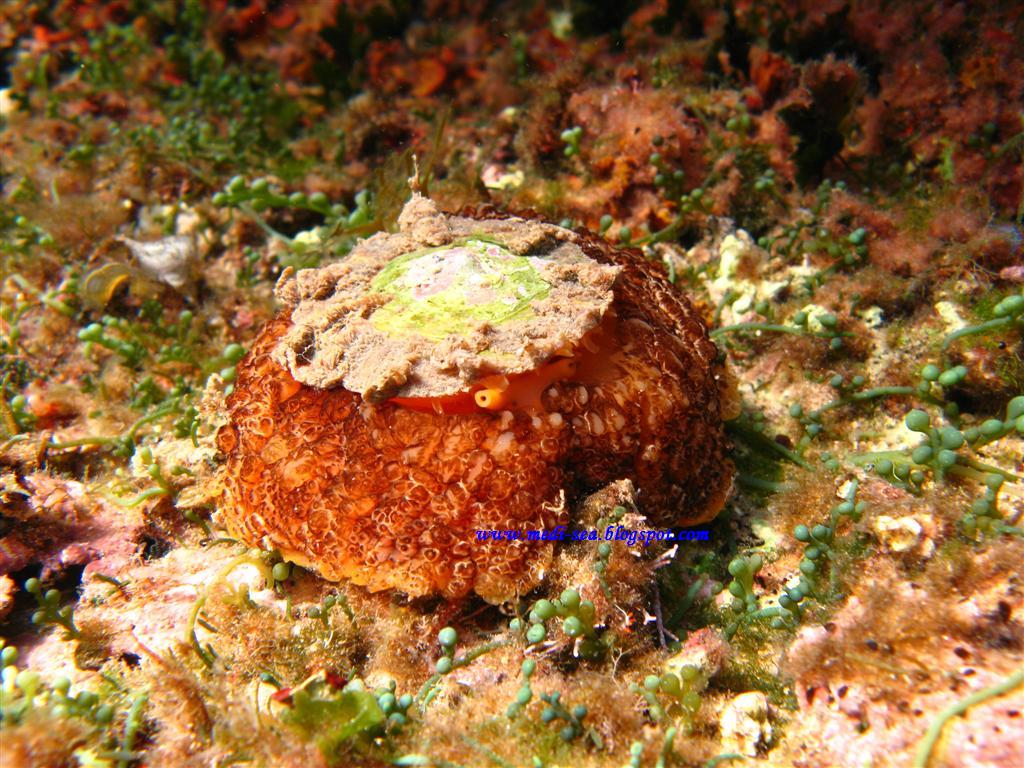
The Green Ormer


These shells are popularly called sea-ears and the scientific name Haliotis comes from the Greek halios and otis meaning ear.
They are a single shelled gastropod that crawls over the rocks feeding on algae. It can grow up to 12 cm and the interior of the shell is a magnificent wavy mother-of-pearl covering. They have separate sexes and breed in the summer. Masters of camouflage with calcareous algae and other seaweeds living on their shell, they can easily be sniffed out by octopus..look closely in the following picture


Their flesh is prized both by men and octopi... today, on what it seems like the last dive of the year,..a very big ear-shell was just about to be eaten by a viciously hungry octopus, when "tank girl" came to the rescue to get a photo...the octopus left slowly towards the right leaving the very expanded shell to its peace, towards the left.
In this incident we can see the rare situation of the shell's mantle being completely expanded outwards giving it a frilly white margin, and the octopus looking very annoyed...
It seems the French love this shell and it has a history for heavy fishing north until the Channel Islands, where they first beat the hard flesh and then fry it////it is delicious!

So, to close off this first year of Medi-sea..adventures

Sea ear, Sea ear
if you can hear
all we want for New Year

No more all around trawling gear/fear

MARINE PROTECTED AREAS IN GREECE, NOW


and many love Hugs and Fishes
to All and to All good night

20 Dec 2009

Christmas slug lights up the sea!


Dear friends of Medi Sea
Christmas is nearly here and we wanted to celebrate this time
with the most festive of Eastern Mediterranean slugs!
Janolus cristatus is a strikingly
beautiful opisthobranch and we nicknamed it "the bulb" (γλόμπος) because its
cerata are very much like glowing bulbs. If you look closely inside the transparent cerata you will notice the digestive gland ducts, which look like mushrooms!

These animals can grow to 75 mm in length and love to feed on bryozoans.
As beautiful as they are, they are very fragile so better not to touch them, only admire them from a distance.
Their egg sacs look like packets of pearls.
This specimen was photographed in Pilio but it's distribution reaches as far North as
Chalkidiki!
Happy Holidays
Happy Christmas dives
and all we want for Christmas is:
MARINE PROTECTED AREAS IN GREECE

6 Dec 2009

Remember, remember the 6th of December

One of the last pictures I took with my camera (before I violently drowned it, yesterday), was this wicked crab, called Dromia personata that is completely invisible unless it starts eating a jelly fish right in front you!


If you look closely on the middle left of the picture, you will see the side of the sponge crab under its well fitted sponge cover, grabbing the jellyfish by its tentacles and slowly eating it!


So there you see one crab, but the shock was the other one that is hiding behind the jellyfish! And both of them had the jellyfish clawed by both sides! Was it a well thought of attack?Do crabs like to eat jellyfish and work together to capture it?!
Both crabs had a 15cm carapace covered by a well attached sponge, making them COMPLETELY invisible!
These sponge crabs are very curious in that the front of their body is hairy, and the edge of its two front claws is bright pink. Although they may be pink they are huge and should be avoided...poor jellyfish

30 Nov 2009

Crab duo...

Spidercrabs love anemones, and the anemones love the crabs. It seems that neither animals are hurt in this beneficial relationship, the crab is protected by the poisonous tentacles and the anemone is warned for any predators before anyone can suspect otherwise. You see, these crabs cannot be seen easily, you may be taking a picture of one and the other would be giggling behind a tentacle! Amazing camouflage and very hard in identification, unless the carapace is available for closer examination, for example when the crab is shedding. Maybe next time...I know where you live....
Sometimes they like to cover up with sponges, like another resident of Kalogria which will be on the next post.
Until then happy crab hunting!


Photo taken on this last Sunday of November in Kalogria.

25 Nov 2009

the king of blennies


One uncommon and endemic in the Mediterranean sea specie of blennie is Salaria basilisca. Blennie-basilic is very similar with Salaria pavo but it has small differences in the white marks of her body and it doesn’t have the ring behind the eye that we can see at S.pavo. It lives in the very shallow water hiding in small caves and it is hermaphrodite. It born as a female and as it get older turns to male. The head of the male individuals can grow that strange “crown”. Probably can stay over the tide level as does the S.pavo .

22 Nov 2009

Under my umbrella


The umbrella snail is still a little confusion for the scientific research. There are probably two common species worldwide the Umbraculum umbraculum (Indo-Pacific region) and the Umbraculum mediterraneum (east Atlantic-Mediterranean region). A lot of researchers confuse this two species. More species of the family Umbraculidae have been found as fossils or just once. As we know most of the species of the (Subclass) Opisthobranchia have no shell. U.mediterraneum and Tylodina pervesa are the strangest species of the subclass as they have a small shell that looks like an umbrella over their body. U.mediterraneum is feeding on sponges and for that reason has a broad radula with rasping teethes. It can also bury in the sand near the sponges that it prefers for feeding. If you find it on the rocks it maybe impossible to spot as it can hide all his body between the umbrella shell and the rock. The animal in the photo was met at Paros at the depth of 1 meter and it is the shallower I have ever met.